
Business Valuation of Construction Companies
Construction is one of the most economically complex industries we encounter in our valuation practice. It is also one of the most frequently mishandled, not because the businesses are exotic, but because they look deceptively simple on paper. A contractor with $5 million in revenue and a handful of active projects can generate financial statements that tell a completely different story than what the business is actually worth.
The Industry, In Plain Terms
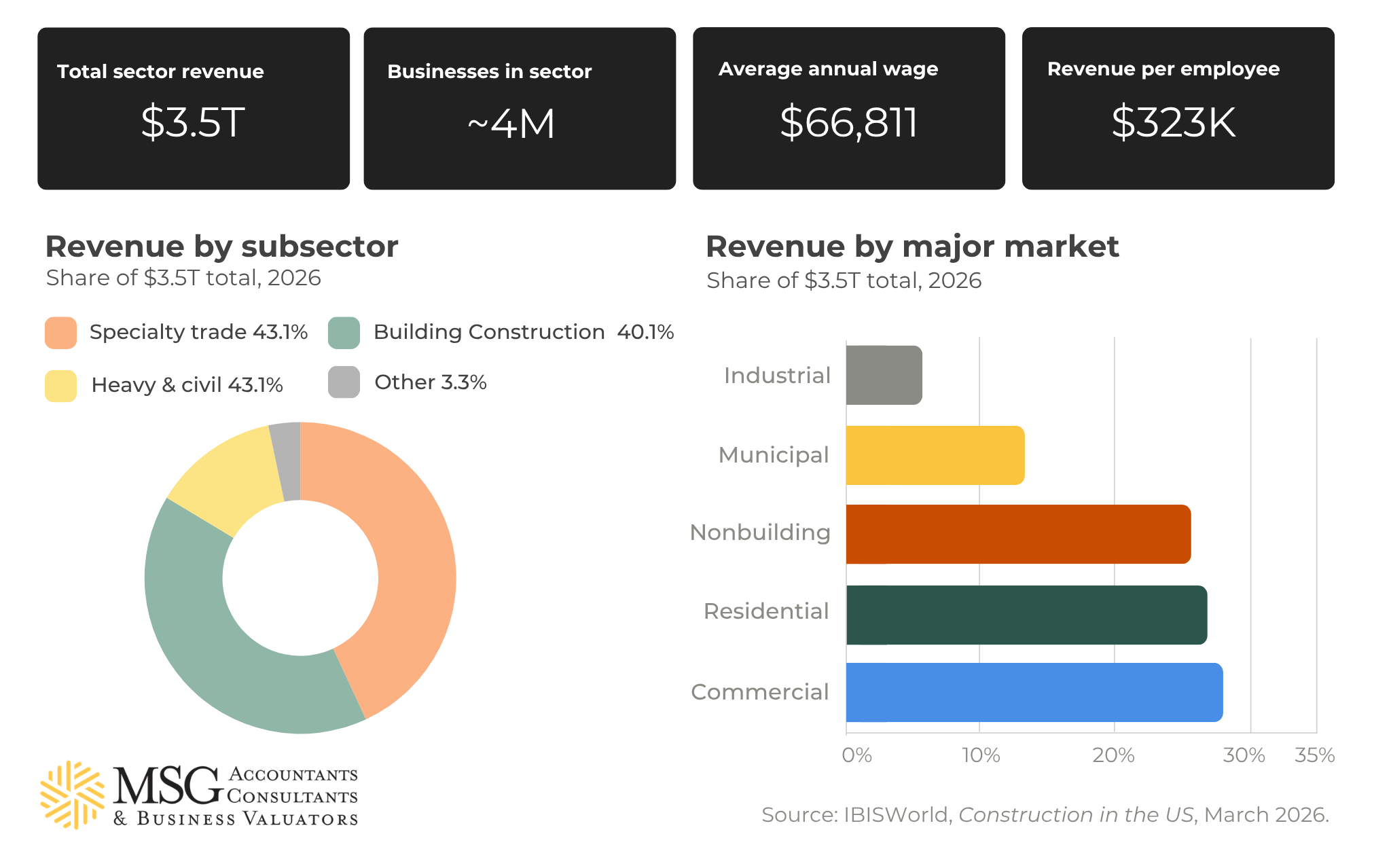
The US construction sector generates approximately $3.5 trillion in annual revenue across nearly 4 million businesses.1 Most of those businesses are small, closely held, and operate within a limited geographic area. That last point matters enormously for valuation purposes. This is not an industry dominated by national players. The largest single contractor in the country accounts for less than 1% of total sector revenue.2 The typical subject company in a litigation matter generates under $1 million annually and depends on a handful of relationships, a regional reputation, and the continued involvement of its owner to sustain that revenue.3
The sector spans three primary categories: specialty trade contracting, including electrical, plumbing, concrete, HVAC, and related work, which accounts for roughly 43% of revenue; building construction at about 41%; and heavy and civil engineering, including bridges, highways, utilities, and pipelines, at just over 13%.4 Each subsector carries distinct valuation characteristics.
The operating environment in 2026 is not simple. Materials costs, after a brief moderation, resumed climbing at nearly 3% year-over-year in 2025, driven largely by tariff-related supply chain disruption affecting lumber, steel, aluminum, and copper.5 Labor shortages have intensified: a 2025 survey by the Associated General Contractors of America found that 92% of contractors reported difficulty filling positions, with immigration enforcement actions directly affecting operations on more than a quarter of jobsites.6 Wages represent approximately 21% of revenue across the industry, a ratio that has held remarkably stable for two decades and is among the first benchmarks I reach for when normalizing a subject company’s financials.7
How Construction Businesses Work
Large projects are typically managed by a general contractor who negotiates the contract, builds the schedule, procures materials and equipment, and then farms the actual construction work to subcontractors. Those subcontractors generally fall into two categories: those handling ground-up work, including foundation, framing, and roofing, and those handling finish-out work, such as electrical, plumbing, painting, and HVAC. Finish-out subcontractors command higher rates, as their work requires greater technical specialization.
Contracts in this industry come in three basic forms: fixed price, guaranteed maximum cost, and cost-plus-fee. Each carries a different risk profile for the contractor, and each creates different cash flow dynamics. What they share is the fundamental characteristic of construction finance: revenue is received in irregular installments while expenses continue on a predictable schedule. Retainage, the practice of withholding a portion of payment until project completion, is standard. On a large project, a contractor may have hundreds of thousands of dollars in completed work sitting in receivables while simultaneously making progress payments to subcontractors. This is not a sign of financial distress. It is how the industry operates. Distinguishing between the two is one of the core analytical tasks in a construction valuation.
Choosing the Right Valuation Approach
For an operating general contractor with a track record of completed projects and ongoing client relationships, the income approach is typically the most probative. But it cannot be applied without disciplined normalization. Owner compensation in closely held construction firms is frequently distorted; the owner may draw modestly while retaining cash, or generously at the expense of stated profitability. Related-party rent is pervasive, particularly in situations where the owner holds real estate separately from the operating company and charges the business accordingly. Equipment owned outside the business but used in operations must be identified and accounted for.
Work-in-progress is the normalization issue I find most consistently overlooked by generalist appraisers. Contractors recognize revenue on either a percentage-of-completion or completed-contract basis. Depending on the method used and where the valuation date falls in the project cycle, the WIP schedule can materially overstate or understate economic earnings for any given period. A valuation that accepts reported revenue at face value, without tracing it back to underlying contracts and WIP schedules, is not a defensible valuation.
The market approach is useful as a check, but it requires caution in construction. Public company comparables operate at a scale, with capital structures and geographic diversification, that have no meaningful relationship to the closely held regional contractor that is almost always the subject of litigation. Private transaction multiples can provide useful reference points, but they need to be adjusted carefully for size, backlog quality, customer concentration, and subsector. A multiple appropriate for a specialty trade contractor with recurring service relationships is simply not appropriate for a project-dependent general contractor.
The asset-based approach becomes most relevant for capital-intensive contractors, particularly in heavy and civil engineering, where significant equipment holdings represent a meaningful share of enterprise value, and in liquidation scenarios where going-concern assumptions cannot be sustained.
What Drives Construction Business Value, and What Erodes It
In my experience, the factors that most reliably move a construction business’s value within any reasonable range are backlog, bonding capacity, and owner dependency.
Backlog is a measure of future revenue under contract. A contractor with a strong, diversified backlog of signed agreements represents a materially different risk profile than one whose next project depends on winning a bid. Bonding capacity, the ability to secure performance and payment bonds, functions as a proxy for financial health and creditworthiness that has already been independently evaluated by the surety market. A contractor whose bonding capacity has been reduced or eliminated is a contractor whose going-concern value is in question, and that question needs to be addressed directly in any expert report.
Owner dependency is the risk factor most frequently underweighted by opposing experts and most reliably surfaced in cross-examination. In a business where contracts are won on reputation and personal relationships, and where most new work comes from previous clients, the degree to which revenue is tied to the continued involvement of a single individual is a legitimate and material valuation consideration. It affects the discount rate, the selection of market multiples, and, in some cases, whether the income approach is the right framework at all.
License transferability, union versus non-union workforce composition, geographic concentration, and seasonality round out the picture. These are not secondary issues. They are the factors that separate a construction valuation that holds up under scrutiny from one that does not.
A Final Word for Attorneys
Construction valuations reward preparation and penalize shortcuts. The financial statements are complex, the accounting conventions are industry-specific, and the gap between reported results and economic reality can be substantial. Attorneys who understand the mechanics of how these businesses operate, how cash flows, how contracts work, and how value is actually created, are better positioned to evaluate the expert they retain, challenge the expert they face, and ultimately serve their clients well.
Notes
1 IBISWorld, Construction in the US, March 2026. Total 2026 sector revenue projected at $3,496,356.7 million; approximately 3.8 million establishments.
2 Ibid., Companies section. No single company accounts for more than 2.5–5% of industry market share; the largest contractor holds less than 1% of total sector revenue.
3 Ibid., Key Ratios. Revenue per enterprise averaged approximately $912,500 in 2026.
4 Ibid., Products & Services Segmentation. Specialty trade contracting: $1.5 trillion (43.1%); building construction: $1.4 trillion (40.5%); heavy and civil engineering construction: $458.0 billion (13.1%).
5 Ibid., Current Performance. Construction materials prices rose an average of 2.9% year-over-year in 2025, driven by tariff-related supply chain disruption.
6 Ibid., Outlook. Citing Associated General Contractors of America, August 2025 survey: 92% of contractors reported difficulty filling open positions; 28% reported being directly or indirectly affected by immigration enforcement actions.
7 Ibid., Key Ratios. Wages as a percentage of revenue: 20.7% in 2026; ranged between 18.0% and 21.4% from 2004 through 2026.