
The Economic Forces Reshaping Business Valuation in 2026

I think I finally understand what it feels like to be a traveling salesman. The only difference is that I haven’t been selling anything. Instead, I’ve spent the better part of the past month living out of a suitcase, traveling from city to city, sharing my experiences and exchanging ideas with professionals in business valuation, forensic accounting, and litigation support.
My journey began in Salt Lake City, Utah, where I spoke at the National Association of Certified Valuators and Analysts’ Annual Super Business Valuation and Forensic Accounting Services Conference. From there, I headed to Tennessee to discuss the preparation and challenges of expert rebuttal reports at the Tennessee Society of CPAs’ Annual Business Valuation Conference.
After a brief return to New York City, I spoke about how to identify a “rigged” expert report before the New York State Society of CPAs’ Business Valuation and Litigation Support Services Committee, which I chair.
Next came National Harbor, just outside Washington, D.C., where I presented on what it takes to be an effective expert witness at the AICPA’s Forensic & Valuation Services Conference. And because apparently I hadn’t had enough of conference rooms, PowerPoint presentations, and hotel beds, I made one final stop at the Valuation20 (V20) Summit & Conference, sponsored by the American Society of Appraisers, just steps from the White House.
Five conferences, several cities, countless conversations, and more hotel meals than I care to remember.
To say I missed a home-cooked meal would be an understatement.

No matter how long you’ve been practicing, there is always something new to learn, a different perspective to consider, and an opportunity to become better at what you do.
Despite the venue, the biggest concerns all came down to the volatility in the U.S. economy.
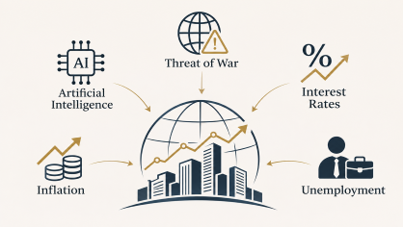
Five topics consistently stood out in the discussions: artificial intelligence, the threat of war, interest rates, inflation, and unemployment. Each has significant implications for business owners, investors, and other stakeholders. I wanted to take this opportunity to share what my colleagues were talking and concerned about.
1. Artificial Intelligence: What Does It Really Mean for Business Valuations?
I’ll admit it. Until recently, I hadn’t given artificial intelligence (AI) nearly the attention it deserves. After attending several conferences over the past month, however, I can no longer ignore the impact AI is having on businesses and, more importantly, what it may mean for business valuations.
AI is changing how companies operate, from automating routine administrative tasks to improving employee productivity and potentially reducing operating expenses. But here’s the question that matters to those of us who value businesses:
Does greater productivity necessarily translate into greater profitability and, ultimately, a higher business value?
Not necessarily.
According to McKinsey’s 2026 Global AI Survey, 80% of respondents reported improvements in their individual productivity from using AI. Yet only 37% reported that AI had made a positive contribution to their organization’s earnings before interest and taxes (EBIT). In other words, while employees may be getting more done, those efficiencies aren’t necessarily translating into higher profits.
For business valuation experts, this distinction is important. We need to look beyond the excitement surrounding AI and examine its actual financial impact. Will it reduce labor costs, improve profit margins, or create new revenue opportunities? Or will the investment in technology, employee training, and implementation offset some or all of those anticipated benefits?
This is particularly relevant in shareholder disputes, matrimonial matters, and other litigation where the future earnings of a privately held business are central to determining its value.
The takeaway is simple:
AI may change how businesses operate, but its impact on value cannot be assumed.
Like any other factor affecting future earnings, its financial benefits and costs must be evaluated on a company-by-company basis and supported by the facts, not simply by expectations about what AI might accomplish.
2. The Threat of War: When Global Conflicts Hit Home
War may be taking place thousands of miles away, but its economic consequences can be felt much closer to home. A business in New York, or any other city, for that matter, doesn’t have to operate internationally to be affected by a conflict in the Middle East. Rising fuel prices, disruptions in the supply of materials, increased transportation costs, and uncertainty about the future can all have a direct impact on its bottom line.
And unfortunately, these concerns are no longer hypothetical.
According to the World Bank’s June 2026 Global Economic Prospects report, global economic growth was projected to slow to 2.5% in 2026, compared with 2.9% in 2025, reflecting, in part, the economic consequences of the conflict in the Middle East. In May 2026, Reuters reported that the war involving Iran had already imposed at least $25 billion in costs on companies worldwide, with businesses responding by raising prices, reducing production, and cutting expenses.
But what does all this mean for business valuations and commercial litigation?
Consider a privately held manufacturing company that historically enjoyed stable revenues and consistent profit margins. Suddenly, the cost of raw materials increases, transportation becomes more expensive, and suppliers are unable to meet delivery schedules. The company’s earnings decline, not necessarily because management has made poor decisions or because the business has lost customers, but because of economic circumstances beyond its control.
For business valuation experts, the challenge is determining whether these conditions represent a temporary disruption or a more permanent change in the company’s earning capacity.
-
- Should a decline in earnings be considered an unusual, nonrecurring event, or does it reflect a new economic reality?
- How should increased uncertainty affect projections of future cash flow and the risks associated with achieving those projections?
These questions become particularly important in shareholder disputes, business divorces, and commercial damages cases. In a lost profits claim, for example, an expert must distinguish between losses attributable to the defendant’s alleged conduct and those resulting from broader economic conditions. Likewise, in valuing a business, an expert must consider the information known or reasonably knowable as of the valuation date, rather than allowing subsequent events to influence the conclusion improperly.
More simply stated:
Global conflicts can affect the value of a business, even when that business has no direct connection to the conflict.
The challenge for valuation and damages experts is not simply recognizing these risks, but determining how they affect the particular company, whether their impact is temporary or lasting, and how that impact can be reliably measured.
3. Interest Rates: A Small Change Can Have a Big Impact on Business Value
Interest rates may not generate the same headlines as artificial intelligence or international conflicts, but their impact on business values can be just as significant. And with interest rates fluctuating over the past several years, understanding their effect has become increasingly important for business owners, valuation experts, and the attorneys who rely on their opinions.
Most business owners understand that higher interest rates mean higher borrowing costs. They can make it more expensive to finance equipment, purchase inventory, expand operations, or acquire another business. For companies carrying substantial debt, increased interest expenses can directly reduce earnings and available cash flow. Even businesses with little or no debt may feel the effects when customers reduce spending or delay purchases.
But what is often overlooked is that:
Interest rates can affect the value of a business even when its revenues and earnings remain unchanged.
In business valuation, we generally estimate value based on a company’s expected future earnings or cash flows and the risks associated with receiving them. These risks are reflected in the discount or capitalization rate used in the valuation process. As interest rates rise, investors may demand higher returns to compensate for the increased cost of capital and the availability of alternative investments. All else being equal, a higher required rate of return translates into a lower business value.
Consider a privately held business generating $1 million in annual sustainable earnings. Using a capitalization rate of 20%, the indicated value would be $5 million. Increase that rate to 22%, without changing earnings, and the value declines to approximately $4.5 million. That’s a reduction of nearly $455,000, or 9%, simply because of a change in the required rate of return.
Interest rates can also influence the prices buyers are willing and able to pay for businesses. Higher financing costs may reduce borrowing capacity, make acquisitions less attractive, and place downward pressure on transaction multiples. As a result, a company that might have attracted a multiple of six times earnings in one interest rate environment could command a lower multiple in another, even if its financial performance has not changed.
For commercial litigators, these considerations are particularly relevant. Two valuation experts may agree on a company’s historical earnings and future prospects but reach materially different conclusions because of the discount or capitalization rates they apply.
The important question is whether those rates appropriately reflect market conditions, the company’s particular risk characteristics, and the circumstances existing as of the valuation date. A rate should not be increased simply because interest rates have risen, nor should an expert automatically assume that a change in borrowing costs produces an equivalent change in the company’s cost of equity.
Interest rates can influence business value in more ways than one. Their effect extends beyond financing expenses to the returns investors require and the prices buyers may be willing to pay.
4. Inflation: When Rising Revenues Don’t Mean a Growing Business
Inflation has been one of the most persistent economic concerns of the past several years, and it has remained a recurring theme in my conversations with colleagues. For business owners, it shows up in higher costs for materials, wages, rent, insurance, and nearly everything else it takes to keep the doors open.
And the pressure hasn’t let up.
According to the U.S. Bureau of Labor Statistics, consumer prices rose 0.4% in October 2026, following a 0.6% increase in September. Because of data gaps caused by the 2025 government shutdown, the BLS did not publish an annual inflation rate for October. The most recent annual figure, for September, showed consumer prices up 3.7% from a year earlier, nearly double the Federal Reserve’s 2% target. Energy has been a significant driver, with gasoline prices up 37.4% over the past twelve months.
Most people think of inflation as a cost problem. And it is. But for business valuation experts, inflation poses a subtler challenge: rising revenues don’t necessarily indicate that a business is growing.
Consider a company whose revenues increased 4% last year. On the surface, that looks like growth. But if prices across the economy rose by roughly the same amount, the company may not be selling any more products or serving any more customers than it did the year before. It may simply be charging more for the same volume of business. In real terms, it may be standing still.
Inflation also affects the long-term growth rate used in a valuation. The capitalization rate is generally derived by subtracting an expected long-term growth rate from the discount rate, and that growth rate typically includes an inflation component. Return to the business generating $1 million in annual sustainable earnings. With a discount rate of 22% and a long-term growth rate of 2%, the capitalization rate is 20% and the indicated value is $5 million. Assume instead a long-term growth rate of 4% because recent revenues have been rising with inflation, and the capitalization rate drops to 18%, increasing the indicated value to approximately $5.56 million. That’s a difference of more than $550,000, or about 11%, based on a single assumption.
For commercial litigators, this is an assumption worth scrutinizing. An expert who treats recent, inflation-driven revenue increases as evidence of sustainable growth may overstate a company’s value or a plaintiff’s lost profits. On the other hand, an expert who ignores inflation entirely may understate the earnings a business can reasonably be expected to generate.
Put another way:
Inflation can make a business look like it’s growing when it’s simply charging more.
When reviewing an expert’s report, it’s worth asking how much of the company’s projected growth comes from selling more and how much comes from simply charging more. The answer can have a significant effect on the expert’s conclusion of value.
5. Employment Trends: What the Labor Market Tells Us About Business Value
The strength of the labor market is another important economic indicator that can tell us a great deal about the financial health of a business and its future prospects.
According to the U.S. Bureau of Labor Statistics, the unemployment rate declined slightly to 4.1% in October 2026, compared with 4.2% in September. While that may not seem like a significant change, employment trends can have a meaningful impact on businesses, particularly when it comes to managing expenses, attracting qualified employees, and maintaining profitability.
Consider a business struggling to find skilled employees. To attract and retain qualified workers, management may need to increase wages, offer additional benefits, or rely on more expensive temporary labor. These added costs can reduce profit margins, particularly when the company cannot pass them along to its customers.
On the other hand, rising unemployment presents a different set of challenges. When consumers become concerned about their jobs or financial security, they tend to spend less. For businesses dependent on discretionary consumer spending, even a modest decline in demand can have a significant effect on revenues and profitability.
But there’s another consideration that often gets overlooked in business valuations:
Not all companies, or even all industries, experience the labor market in the same way.
A professional services firm that depends heavily on a few highly compensated employees may be affected very differently from a manufacturing company with a large hourly workforce. Likewise, a business facing a shortage of skilled workers may continue to experience increasing labor costs even when the national unemployment rate is rising.
For business valuation experts, the challenge is determining how these employment trends affect a company’s ability to generate future earnings. Are increased payroll expenses temporary, or should they be reflected in future financial projections? Can the business maintain its current staffing levels? Will changes in consumer demand affect its ability to sustain historical revenues?
These questions are particularly relevant in shareholder disputes, business valuations, and economic damages cases, where the reasonableness of projected revenues, expenses, and profit margins can have a significant impact on the expert’s ultimate conclusion.
Final Thoughts: A Few Lessons from the Road
After a month of traveling, I came home with a few valuable lessons.
First, I discovered that hotel laundry and dry-cleaning services can make even the most expensive dry cleaner in New York City seem like a bargain.
Second, and perhaps more importantly, I was reminded why I enjoy attending and speaking at professional conferences. Beyond the presentations and lectures, it’s the conversations with colleagues, the exchange of ideas, and the opportunity to step away from our daily engagements that make these experiences so worthwhile.
When we’re immersed in financial statements, expert reports, and litigation deadlines, it’s easy to become so focused on the details of a particular assignment that we lose sight of the bigger picture.
Whether we’re talking about artificial intelligence, international conflicts, interest rates, or employment trends, these are not simply headlines in the business section of the newspaper. They are economic forces that can directly influence a company’s profitability, financial outlook, and ultimately, its value. And no two businesses will necessarily be affected in the same way.
I returned to our offices in Rockefeller Center eager to share what I had learned with my team and to discuss how these developments might affect the work we do for our clients.
For commercial litigators, these issues are worth paying attention to as well. Whether you’re handling a shareholder dispute, pursuing a claim for lost profits, or preparing to cross-examine an opposing valuation expert, understanding the economic assumptions underlying an expert’s conclusions can make a meaningful difference. Sometimes, the most important question isn’t how the expert arrived at a particular number, but whether the assumptions used to get there make sense.
After all, valuing a business isn’t just about understanding where it has been financially. It’s also about understanding where it may be headed and the economic forces that could affect its future.
These are exactly the kinds of issues I enjoy exploring in my weekly Zoom call, Tuesdays with Mark, where I answer questions from attorneys about business valuation, economic damages, and forensic accounting.
If you have a question about a valuation issue, an expert report, or a financial dispute you’re encountering in your practice, I’d welcome the opportunity to discuss it. And even if you don’t have a particular question, I hope you’ll join us for the conversation. Register here for Tuesdays with Mark.You can also contact our team at 646-661-3800.
Read More Blogs on Business Valuation: